
[SOLUTRANS+] Energy crisis: road freight transport under severe pressure
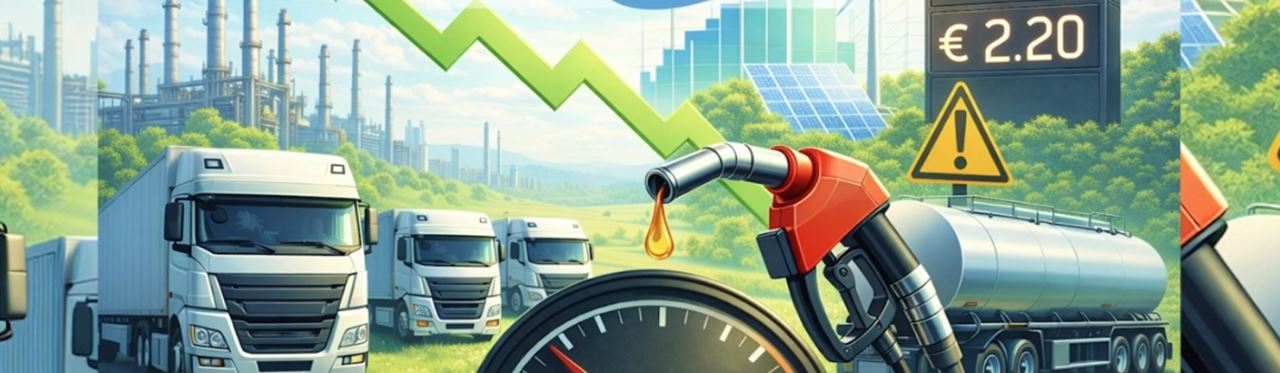
Energy crisis: a 1970s-style oil shock for the road freight sector?
The question arises immediately. The surge in oil prices, driven by the conflict in the Middle East, is disrupting all economic sectors—starting with road freight transport. According to Anne-Sophie Alsif, Chief Economist at BDO France, the comparison with past oil shocks is both relevant and nuanced: "The speed of the increase has been very strong and largely imposed. And we are not returning to pre-crisis levels."
Two factors support this analogy: the rapid pace of the increase and its persistence over time. Initially expected to be short-lived and localized, the conflict has become prolonged, with potential geographic escalation keeping markets under pressure. While oil prices were still around $65–70 per barrel at the end of 2025, the trajectory has since risen significantly.
However, the economist tempers concerns: inflation remains contained at around 2%, in line with European Central Bank targets. Strong US growth—driven in part by $400 billion in AI investments by 2030—and the relative resilience of Asian economies are, for now, keeping recession risks at bay.
Diesel: structurally high prices ahead?
On price outlook, the message is clear: a return to $65 per barrel in the short term is unlikely. Volatility remains high, influenced by US political developments, but the baseline has structurally shifted upward."We may remain in the long term at around or above $100 per barrel. We will have to adapt," explains Anne-Sophie Alsif.
The Strait of Hormuz remains the key geopolitical factor. Any disruption, whether a full closure or reduced traffic flow, would have immediate consequences on Asian supply chains and global growth. A risk closely monitored by economists.
Hauliers on the front line: “€25,000 in additional monthly costs”
Guillaume Jacquemart, President of Transports IDELOT and Board Member of OTRE, puts concrete figures on the crisis. Since the end of February, diesel prices have risen by €0.60 to €0.65 per litre (excluding tax). For a fleet of around 20 trucks, like his company based in the Oise region and specializing in public works, this represents an additional €25,000 in just one month. "We’ve been living in a ‘permacrisis’ for five years. Cash flow and margins have been eroding for over five years now."
The urgency lies in both liquidity and cost pass-through. On the shipper side, responses remain mixed: some clients, particularly in construction, are locked into long-term fixed-price contracts. As a result, the value chain absorbs the shock without being able to pass it downstream.
Road freight transport: support measures deemed insufficient
In response, the French government announced several measures: a €500 flat-rate subsidy per tractor unit (degressive depending on vehicle type), a fuel loan via Bpifrance, and a fleet electrification plan.However, for Guillaume Jacquemart, these measures are neither sufficient nor timely. Three weeks after the announcements, none had yet been implemented.
The Bpifrance loan, in particular, is heavily criticized: offered at relatively high interest rates, it forces some companies to subscribe under pressure, potentially worsening already fragile financial situations. The sector’s priority is clear: unlock support measures, quickly.
The industrial vehicle sector also under strain
The crisis is not limited to transport operators. It affects the entire industrial vehicle value chain.
Philippe Sandrin, President of TIB and member of FFC Équipements et Véhicules, illustrates this from Normandy. As a bodybuilder manufacturer specializing in ambulances and special vehicles, he already faced a difficult 2025, with a 30% drop in light commercial vehicle registrations, before being hit by a sharp increase in raw material costs. "We are seeing increases of 15% to 30% on raw materials. Sandwich panels, aluminium, steel sheets, beams—everything has risen abnormally."
To cope, he has adopted a pre-purchasing strategy: securing six months’ worth of raw materials to mitigate both shortages and further price hikes. A decision that requires strong cash flow, something many companies no longer have.
Industrial vehicles: price pressure eroding margins
The paradox is stark: in a highly competitive environment, bodybuilders cannot pass on cost increases without risking losing contracts. Worse still, in public tenders, price is once again taking precedence over environmental and quality criteria. "I’m seeing tenders where price accounts for 70% of the score again. I hadn’t seen that in 15 years." , says Philippe Sandrin. A concerning regression for the sector.
Energy mix: the only sustainable path forward?
All speakers agree: there is no short-term miracle solution. The response must be structural and lies in diversifying the energy mix. France has a strong comparative advantage with its decarbonized nuclear energy, which must be fully leveraged. "In economics, the key word is diversification. And now is the time to use our comparative advantages", says Anne-Sophie Alsif.
While electrification is a serious pathway for heavy-duty vehicles, it is not the only one. Hydrogen, heavily invested in by China, also remains a key area to watch. What is certain, according to Philippe Sandrin, is that reducing energy consumption is no longer optional: "We have no choice. We must move toward electric chassis, because electricity will prevail over oil."
SOLUTRANS+: a collaborative tool to navigate the crisis together
The webinar also introduced SOLUTRANS+, a new application dedicated to the industrial and urban vehicle sector, set to launch on June 1.
Patrick Cholton, President of SOLUTRANS, outlined its ambition: a free tool designed not as a passive information channel, but as a true collaborative hub for the entire industry."From drivers to business leaders, this application must become the sector’s reference tool."
Features will include real-time raw material prices (aluminium, steel, copper, rubber), currency tracking, regulatory updates as soon as they are published in Brussels, sector studies, and access to a database of tens of thousands of industry contacts.
Want to stay informed about the launch of SOLUTRANS+? Subscribe to the newsletter to be notified as soon as the platform goes live and get early access to its content and services.